
Why Recovery Phrases Are More Secure Than Passwords
Every year, billions of passwords are exposed through data breaches, phishing attacks, password reuse, and weak security practices. Despite password managers and two-factor authentication, traditional passwords remain one of the biggest security weaknesses online.
Recovery phrases offer a different approach one that gives users greater control over their accounts without relying on passwords.
What Is a Recovery Phrase?
A recovery phrase is a sequence of randomly generated words that acts as the master key to your account or digital wallet.
Unlike a password, which is usually stored (in hashed form) on a company's servers, a recovery phrase is typically generated on your device and should only be known by you.
If you lose access to your device, your recovery phrase allows you to restore your account.
Why Passwords Fall Short
Passwords have several well-known weaknesses:
People reuse the same password across multiple websites.
Weak passwords are easy to guess or crack.
Users can be tricked into revealing passwords through phishing.
Companies storing password databases become attractive targets for attackers.
Forgotten passwords require centralized recovery systems.
Even when passwords are encrypted, stolen password databases can still be attacked using brute-force or dictionary methods.
Why Recovery Phrases Are More Secure
Recovery phrases eliminate many of the problems associated with passwords.
1. No Password Database to Steal
Traditional services must store password hashes on their servers.
Recovery phrase-based systems don't require password databases, reducing one of the most common attack targets.
2. Higher Entropy
Recovery phrases are generated from carefully selected word lists and contain far more randomness than the average user-created password.
A properly generated 12-word recovery phrase is significantly harder to guess than even a strong password.
3. User Ownership
With passwords, recovering an account often depends on email verification or customer support.
Recovery phrases place account recovery directly in the user's hands.
If you securely store your recovery phrase, you can restore access without depending on third parties.
4. Reduced Attack Surface
Recovery phrases are designed to be used rarely typically only when restoring an account.
Passwords, on the other hand, are entered regularly, increasing opportunities for phishing, key-logging, or accidental exposure.
Recovery Phrases Also Have Responsibilities
Recovery phrases are powerful, but they require careful handling.
You should:
Write your recovery phrase down.
Store it somewhere safe and offline.
Never share it with anyone.
Never upload it to cloud storage or messaging apps.
Create multiple secure backups if necessary.
If someone obtains your recovery phrase, they may be able to access your account. There is no "Forgot Recovery Phrase" button.
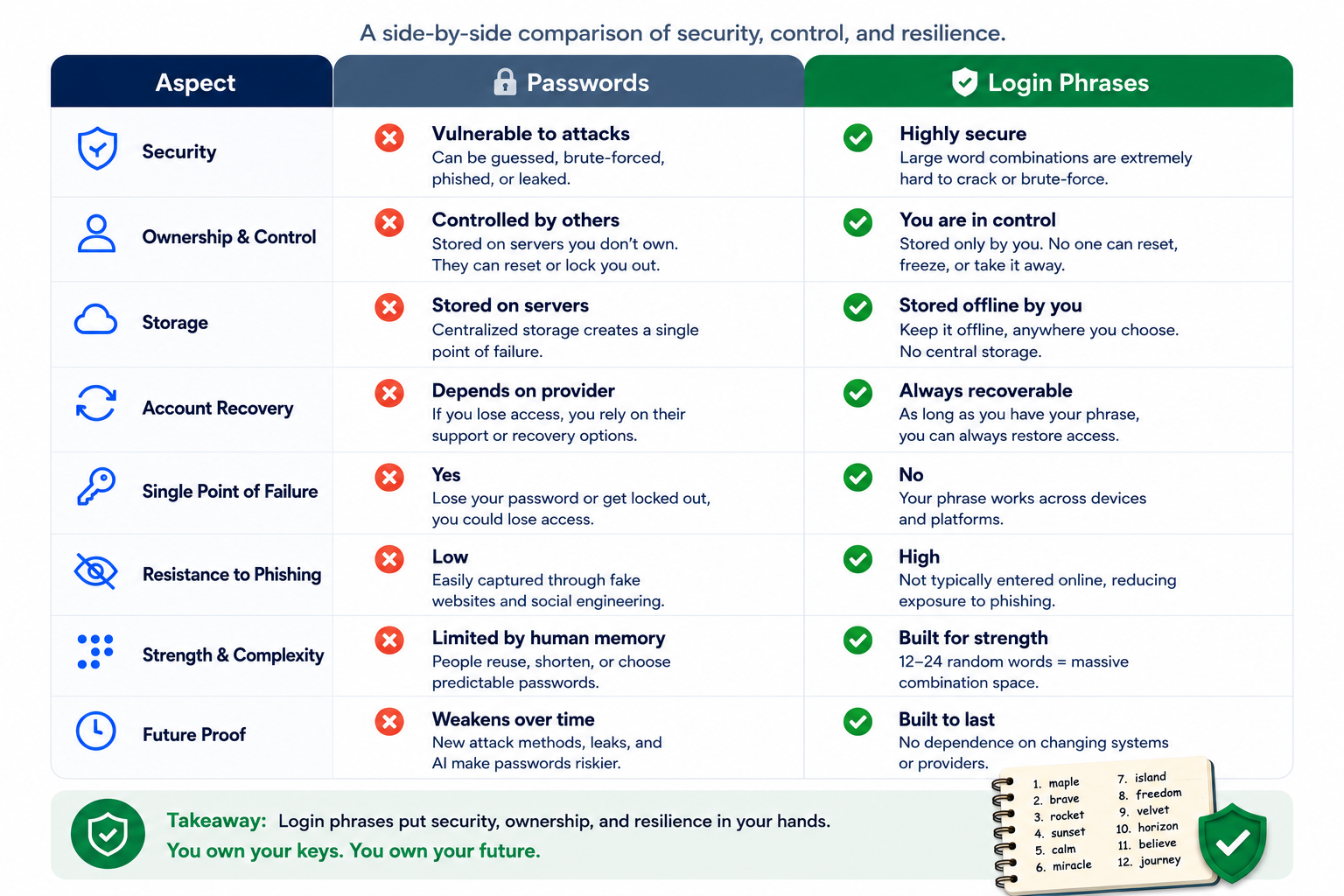
Recovery Phrases vs Passwords
Passwords
Easy to forget
Frequently reused
Stored by many services
Vulnerable to phishing
Require password resets
Recovery Phrases
Randomly generated
Extremely difficult to guess
User-controlled
No traditional password database
Used primarily for account recovery
How Quidsnetwork Uses Recovery Phrases
At Quidsnetwork, your account is built around a login phrase (recovery phrase) instead of a traditional username and password.
This approach aligns with our privacy-first philosophy. By removing passwords from the authentication process, we reduce reliance on centralized account management while giving users greater ownership of their accounts.
Your login phrase (recovery phrase) is generated on your device and is your responsibility to protect. Quidsnetwork cannot recover it for you, which means only you control access to your account.
Final Thoughts
Passwords have served the internet for decades, but they come with limitations that have become increasingly difficult to ignore.
Recovery phrases represent a shift toward stronger security and greater user ownership. They reduce reliance on centralized systems and eliminate many of the weaknesses associated with traditional passwords.
As more privacy-focused technologies emerge, recovery phrases are likely to become an increasingly common way to secure digital identities.
Whether you're protecting cryptocurrency, encrypted data, or your conversations on Quidsnetwork, understanding how recovery phrases work is an important step toward taking control of your digital security.